
‘Savage House’ (2026)
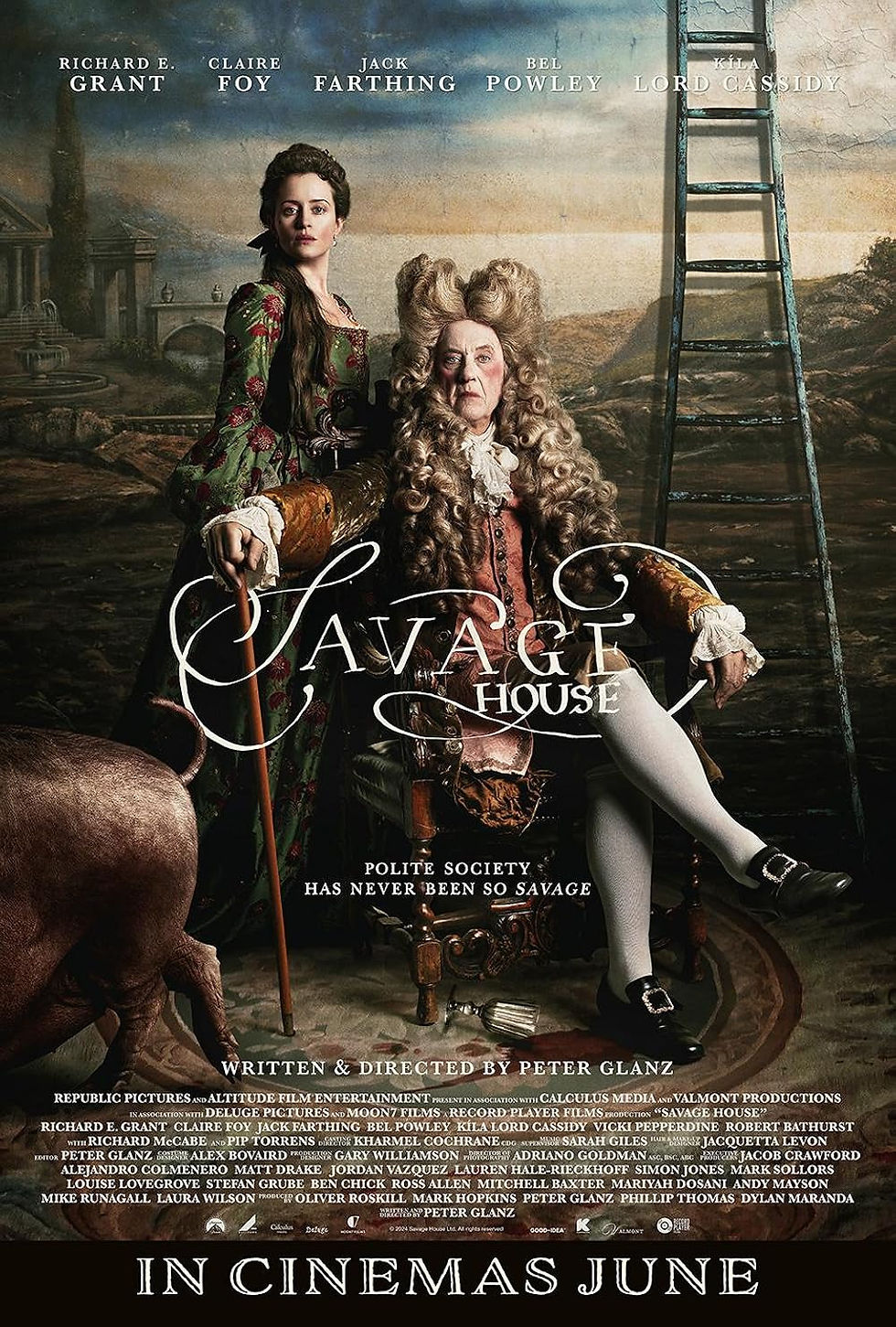
Set in 18th century England, Savage House serves as the residence of Sir Chauncey Savage (Richard E. Grant) and Lady Savage (Claire Foy), their daughter Fanny Savage (Kíla Lord Cassidy) and a very stripped back service crew, consisting of footman Reginald Halifax (Jack Farthing), lady’s maid Dorothy Neville (Bel Powley) and their cook.
With Chauncey having climbed the social ladder and married into the title, he and Lady Savage maintain what is an apparently dwindling family fortune and a slowly crumbling estate. Surprised one day by word from esteemed Duke and Duchess of Devonshire, announcing their tour of York to include Savage House, the family make preparations for a dinner that could turn their fortunes around.
Wasting no time, the film opens on detailing the circumstances of Chauncey’s ascension to prominence. Being born of low standing to a farmer, Chauncey had charmed, swindled and cheated his way to a higher status, eventually meeting and enchanting Lady Savage. Succumbing to his vices however, Chauncey enjoys what little remains of the Savage family fortune as he gambles and whores his way around, selling off parcels of land that the Savage family owns, reducing their wealth further.
It is the relationship dynamic between Grant and Foy that really makes the film work. With Grant fully committing to an opportunist persona who has made one too many bad deals, it is Foy’s sharp and adept Lady Savage that manages to hold her own when confronted by Chauncey’s poor decisions, with both performers delivering characters that can go toe to toe any day.
We eventually learn that both Sir and Lady Savage have taken on lovers, with Chauncey charming Dorothy and Lady Savage enjoying a tryst with Halifax. Unbeknownst to both however, Dorothy and Halifax are in cahoots, scheming to rid the house of Chauncey to eventually replace the Savages and enjoy their remaining wealth for themselves.
Excitingly conspiratorial, the film keeps its main story of the preparations for receiving the Duke and Duchess of Devonshire front and centre whilst also maintaining a healthy undercurrent of overlapping interests and betrayals, resulting in many a shocking revelation and hilarious encounters.
With the Savages’ main concern revolving around keeping up appearances, the feature showcases time and time again the lengths to which both Sir and Lady Savage will go to iron out kinks in their household. Plagued by treacherous staff, illness and eventual comeuppance however, the Savages learn that having sold off their heirlooms and the Devonshires cancelling their visit at late notice, the film invites us to reflect on the worth that we place in impressing those who admittedly may not care or matter.
Recurring throughout the film, regal imagery, lavish surroundings and period-specific costumes are blended with scenes of unsightly, yet period appropriate settings. Poorly kept kitchens and medical practices of the time drive home the dichotomy of life at the time. The Savages may have the latest apparel, yet this is all to disguise a rotten core. Plastering over a decrepit manor with what little they have left, Chauncey eventually breaks down as he is unable to ignore the cracks in the walls, collapsing in on himself when unable to forget his humble beginnings and the judgement others may pass on him for it.
Capturing so perfectly the outdated medical treatments of the time, the feature showcases the now admittedly wrong and frankly disgusting methods employed at the time to deal with issues like gout and severe infection. Inviting us to recoil at the horrendous and vile practices, ‘Savage House’ shines as it contrasts the abundance and excess with which the Savages live to the underdeveloped and barbaric procedures we used to consider medicine.
Writer and director Peter Glanz brings us a story that sways between the absurd and bleak, exploring the inner workings of noble families and how little there is to their dignity and stateliness when it comes to maintaining the status quo and how far they will go to keep climbing the social ladder. With the tone shifting from darkly comedic to heartbreakingly gloomy, sometimes within the same scene, ‘Savage House’ provides excellent laughs and some introspection. However, without diving too deep, the film perhaps misses its mark and fails to land a poignant and effective punch.
Hitting hard with outrageous laughs, vile displays of various maladies and managing to sneak in moments of abstract self-reflection, ‘Savage House’ is missing a key factor of deeper examination of the moral qualms it raises. The feature touches on avarice and envy but does not care to go beyond simply raising the issues, rather than examining the root cause.
Grant takes great joy in fully committing to his despicable and grubby Chauncey, with the character suffering a malady induced fever-dream, where he hallucinates a pig wandering the halls of Savage House. Leaving the abstract imagery to fend for itself, Chauncey’s failure to verbalise his deepest fears results in nothing more than emotional detachment from the core of the story. Worth the watch simply for the pure joy that Grant and Foy bring to the screen, their indelible characters are delectably unslakeable, yearning for more and giving up everything in the process.
Score: 2/4


Comments